
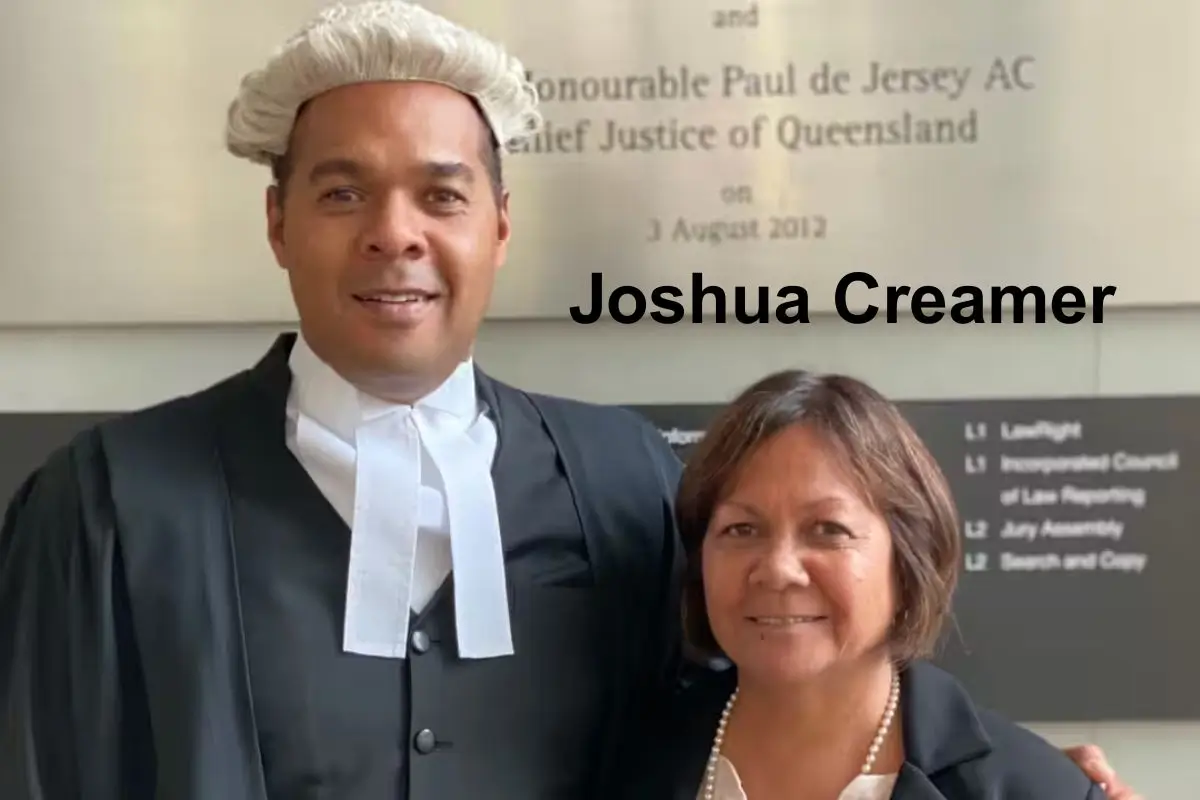
Queensland-born Waanyi and Kalkadoon lawyer Joshua Creamer’s legal work has influenced the country’s discourse on historical injustice, truth-telling, and First Nations rights. He was born and reared in Queensland, and before pursuing a Graduate Diploma in Legal Practice, he earned a Bachelor of Arts and a Bachelor of Laws from Griffith University. He was originally called to the Bar on February 28, 2011, and he now has an unconditional practicing certificate. He practices at Aspect Chambers on Level 19, 239 George Street in Brisbane, where he specializes in large class actions, public law, administrative cases, human rights litigation, and significant investigations aimed at redressing historical abuses of Indigenous people.
Childhood and Family History
Joshua Creamer is from the Waanyi and Kalkadoon peoples in northwest Queensland, where he was born and reared. Like many First Nations families in the area, his family’s history is influenced by his ties to the country as well as the effects of state laws that limited opportunities, government control, and mission life. Joshua grew up hearing the tales of elders and family members who had been forced to relocate, had their wages controlled, and had been displaced due to regulations that had regulated many facets of Indigenous life for many years. His early knowledge of the intersections of power, laws, and lived experience for Aboriginal families in Queensland was shaped in part by these experiences.
Joshua was impacted from an early age by his family’s strong sense of identity and cultural resilience. He was surrounded by communal values that prioritized respect for elders, education, and historical knowledge. These principles influenced his lobbying style and ultimately fueled his desire to use the judicial system to reveal the consequences of colonial laws. His growth was greatly aided by his mother, Sandra Creamer, whom he subsequently persuaded to enroll in human rights education courses so she could advocate for Indigenous causes as well. Eventually, her tale became well-known throughout the country, demonstrating how different generations of the same family may influence institutional, cultural, and legal change.
Joshua’s legal profession was shaped in part by his early years. His choice to study law as a means of addressing persistent injustice was influenced by a mix of his family background, community experience, and exposure to structural disadvantage. His work in truth-telling, class actions, and leadership positions, where he aims to not only correct historical wrongs but also make room for Indigenous voices at all levels of the legal system, is still influenced by the teachings he learnt from his childhood.
Early Human Rights Education and Activism
Joshua had an early interest in human rights. He enrolled in the Diplomacy Training Program in 2004 and gained useful lobbying skills for human rights. Additionally, he took part in the Oxfam Youth Parliament, an initiative that brings young people together to talk about global equality, sustainability, discrimination, and Indigenous rights. He developed an early understanding of the law as a tool for solving actual social issues rather than just as regulations on paper as a result of these encounters. His mother, Sandra Creamer, was eventually persuaded to participate in a similar program by him, and her own journey in Indigenous activism was subsequently featured nationally. Joshua has also contributed to the training of upcoming Indigenous activists, helping them to acquire understanding of community law and human rights legislation.
Leadership, Awards, and Professional Appointments
Joshua has had a number of significant leadership positions in addition to practicing law. He joined the Board of Legal Aid Queensland in 2017. Later on, he joined the Queensland Law Reform Commission as a Commissioner, helping to evaluate and update the state’s laws. Additionally, he served as head of the Queensland Bar Association’s Indigenous Affairs Committee. As the chair of the Griffith University Elders and First Peoples Knowledge Holders Advisory Board and a member of the Griffith University Council, he has made contributions to higher education governance.
Joshua’s efforts have been officially acknowledged. His efforts to combat racism earned him the 2008 Rubin Hurricane Carter Award for Social Justice. He was recognized as the Outstanding Young Alumnus of the Year in Arts, Education, and Law at Griffith University in 2013. A national legal rankings agency named him one of Australia’s exceptional young attorneys in 2016. His accomplishments in class actions and advocacy for First Nations people earned him the National Indigenous Legal Professional of the Year Award in 2017.
The Strength of Collective Claims and Class Actions
Joshua has gained notoriety over the course of more than ten years for class lawsuits that have included thousands of First Nations plaintiffs. In these instances, allegations of unfairness, discrimination, and economic loss are constructed using historical records, community evidence, government papers that have been preserved, and economic research. He collaborates with archivists, economists, historians, and elders to gather data, record personal experiences, and make legal claims in court.
According to Joshua, class actions include both the creation of historical records and compensation. They enable the documentation and acknowledgment of events that have been disregarded or dismissed by allowing legal proof to become ingrained in the collective memory. He has pointed out that state laws from previous decades that limited travel, education, and economic independence are directly responsible for many of the disadvantages that First Nations people face today.
Acknowledgment of Racial Discrimination in the Palm Island Case
The class action resulting from Joshua’s death in detention on Palm Island in 2004 was one of the most important lawsuits associated with him. After disturbances, police launched a large-scale operation using tough techniques and highly skilled personnel. According to federal law, racial discrimination was asserted in this case. The Federal Court determined that police conduct constituted unconstitutional racial discrimination after a protracted trial. The settlement resulted in a payment for 447 Palm Island residents worth around $35 million.
The importance of this lawsuit to survivors and their families extended beyond financial gain. It provided acknowledgement from the court system that they had experienced biased policing and unjust treatment. According to Joshua, this case influenced his career and demonstrated how the law may be used to demonstrate unfairness in previously untried ways.
A Century of State Control and Stolen Wages
The stolen wages class action in Queensland, which was brought on behalf of Aboriginal and Torres Strait Islander workers whose salaries were withheld by the State, was another significant judicial victory. For many years, thousands of First Nations people were not allowed to receive direct compensation for their labor while working on cattle stations, in domestic jobs, in agriculture, and in coastal businesses like pearling. Rather, the government managed their finances and collected their pay.
The case demonstrated how this system harmed long-term financial stability and impacted whole families. A settlement of around $190 million was achieved. Joshua has persisted in pursuing similar suits in other jurisdictions, such as a claim for compensation for missing generations in the Northern Territory and an action for stolen earnings in Western Australia. He has explained the feeling of vindication that claimants have, pointing out that many are looking for recognition for their parents and grandparents who were wronged in addition to themselves.
Modern Policy and Structural Disadvantage
Joshua thinks that historical laws are inextricably linked to the disadvantage that Indigenous populations face today. He has criticized government initiatives that solely concentrate on Year 12 parity while claiming to reduce educational inequities. He contends that rather than being encouraged to pursue higher education, Indigenous students are instead steered into low-level diploma programs. This trend, in his opinion, is reminiscent of earlier laws that barred First Nations people from obtaining leadership positions and higher education. According to him, this is an example of innate racism and paternalism in which governments limit chances because they believe they know what communities need.
Leading Queensland’s Truth-Telling and Healing Inquiry

Joshua is now the chair of the Truth-Telling and Healing Inquiry in Queensland. The three-year investigation seeks to provide a common understanding of Queensland’s whole colonial past. Like a royal commission, it has the authority to call or compel witnesses. Referencing estimates that Queensland Native Police forces were accountable for tens of thousands of homicides during colonial expansion, Joshua has compared the effort to carrying out a “murder investigation.” A group of staff members supports the independent investigation.
According to Joshua, the first year is essential for obtaining elders’ oral testimony while they are still able to speak. Additionally, he has pointed out that although there is a wealth of knowledge, time is limited and that documented documents are dispersed among several archives and organizations. Political danger surrounds the investigation, especially in light of Queensland’s election results, which showed that a majority of voters rejected the constitutional acknowledgment of an Indigenous voice. Joshua, however, is steadfast in his commitment to exposing the truth, believing that open communication and recognition of the past are crucial first steps in achieving reconciliation.
According to him, individuals in Queensland are more knowledgeable about global conflicts or ancient civilizations than they are about colonial policy. He contends that truth-telling is about justice, respect, and understanding amongst people and that history is shared history.
Justice, Recognition, and Legacy Beyond Compensation
Joshua views truth-telling procedures and human rights class actions as components of a larger endeavor to acknowledge past injustice and foster reconciliation. He hopes that the legal system will be shaped by more Indigenous judges, attorneys, and barristers. He contends that this degree of representation guarantees that legal choices are informed by cultural knowledge, lived experience, and community understanding. In order to make sure that injustice is recognized, documented, and dealt with, Joshua intends to keep pursuing class actions in a number of states.
In the long run, he envisions a judicial system that not only provides restitution but also aids in historical documentation, public education, and future reform. He thinks that the truth takes the place of silence and that court cases have the power to shape history in a manner that will benefit future generations.
Conclusion
After decades of quiet, Joshua Creamer’s work shows how the law may address buried history and assist communities in regaining their dignity. He has established a legacy characterized by justice, recognition, and public understanding by spearheading historic class actions, obtaining compensation for stolen wages, opposing biased police, and chairing Queensland’s truth-telling commission. His method demonstrates that listening to and documenting the truth is the first step toward real transformation by combining legal expertise with historical study, community evidence, and cultural knowledge. Joshua envisions a future in which Indigenous people serve in the legal system as judges, advocates, and community leaders in addition to compensation. His dedication to truth-telling and human rights will continue to raise awareness, influence legislation, and motivate a new generation of First Nations attorneys who are committed to upholding rights and respecting lived experience in the years to come.
FAQs
Who is Joshua Creamer and where is he based?
Joshua Creamer is an Indigenous barrister from Queensland who works at Aspect Chambers in Brisbane, specialising in human rights class actions and public law.
What is Joshua Creamer known for in the legal field?
He is widely recognised for major class actions involving racial discrimination, stolen wages, truth-telling processes and historical compensation claims for First Nations communities.
What happened in the Palm Island class action?
The Palm Island class action arose after a death in custody in 2004 and subsequent police actions on the island. It led to a Federal Court ruling and a significant settlement for hundreds of residents.
What is the stolen wages case in Queensland?
The stolen wages case involved historical laws where the State controlled the earnings of Indigenous workers. The class action resulted in a settlement worth around one hundred and ninety million dollars.
What role does Joshua Creamer play in Queensland’s truth-telling inquiry?
Joshua is Chair of the Queensland Truth-Telling and Healing Inquiry, a three-year process examining colonial history, government policies and lived experiences of First Nations people.
What awards has Joshua Creamer received?
Joshua has been recognised with multiple awards, including the Rubin Hurricane Carter Award, Griffith University’s Outstanding Young Alumnus Award and the National Indigenous Legal Professional of the Year Award.
Why does Joshua focus on Indigenous education and representation?
Joshua believes more First Nations lawyers, barristers and judges are needed in the legal system to ensure cultural knowledge and lived experience inform judicial decisions and public policy.
What is Joshua Creamer’s main goal through class actions?
His main goal is to secure justice, public acknowledgment and financial recognition for communities affected by historical legislation while building legal records that preserve their stories for the future.