
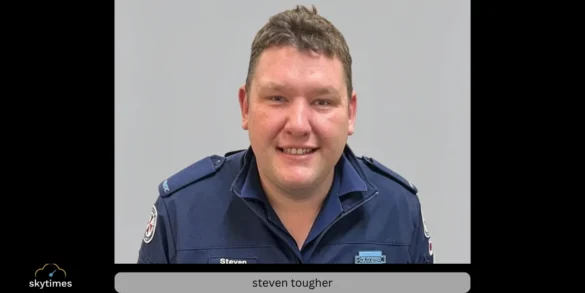
In thirty years of covering stories where personal tragedy becomes the catalyst for public policy change, few have moved me as much as this one. Steven Tougher was a 29-year-old NSW paramedic, newly married and about to become a father, when his life was taken in an unprovoked attack while he was simply on his work break. What followed was not only a deeply painful court case, but a determined campaign by his parents to ensure his death would lead to lasting protection for frontline workers across the state.
Steven Tougher Background
Steven Tougher worked as a paramedic with NSW Ambulance and was pursuing certification as an intensive care paramedic, a role that reflected his lifelong instinct to help others. His parents, Jeff and Jill, have described him as someone who was drawn to caring for people from a young age, recalling how even as a child playing rugby league, he would stop to give first aid to anyone injured on the field rather than continue playing.
A few key facts about his life and career:
- Steven married his wife, Madison, in March 2023.
- He was killed the following month, in April 2023, while his wife was pregnant with their first child together.
- His daughter, Lily-Mae, was born just weeks after his death, in May 2023.
Steven Tougher Key Events
In the early hours of 14 April 2023, Steven was taking a meal break during a night shift, outside a McDonald’s restaurant in Campbelltown, in Sydney’s southwest, when a stranger fatally attacked him.
Expert tip for readers trying to understand cases involving sudden, unprovoked violence: Random attacks by strangers with no prior connection to the victim are statistically rare, but they understandably generate significant public concern precisely because they highlight how little control even careful, safety-conscious individuals have over such encounters in everyday public spaces.
The man responsible, Jordan James Fineanganofo, was subsequently charged with murder. He admitted to the killing but pleaded not guilty based on mental health impairment. During the NSW Supreme Court proceedings, evidence was presented that Fineanganofo had a documented history of psychiatric illness, and that in the days leading up to the attack, he had stopped eating and sleeping properly and had reported hearing voices he believed to be demonic.
Common mistake in the following cases involving a mental health defense: assuming that such a defense means an offender faces no consequences at all. In NSW, a finding of not criminally responsible due to mental impairment results in an offender being held in custody under the supervision of a medical tribunal, which determines when, if ever, release is appropriate, rather than the person simply walking free.
Steven Tougher Investigation and Legal Proceedings
In November 2024, Justice David Davies found that Fineanganofo had established the elements of a mental health impairment defense, ruling that his psychiatric condition meant he did not know his actions were wrong at the time of the killing. Both the prosecution’s and defense’s engaged psychiatrists had reached broadly consistent conclusions regarding his mental state, with prosecutors ultimately agreeing that a special verdict was appropriate.
Following the ruling, Fineanganofo was remanded in custody under the supervision of a mental health tribunal, with further orders made regarding the conditions of his ongoing detention and treatment.
Public Response
The verdict generated a deeply emotional public response, particularly from Steven’s family, who expressed frustration at both the outcome and the process leading up to it. Steven’s father, Jeff, said the family had not been consulted before prosecutors agreed to the special verdict, and expressed profound grief that the system appeared to have failed to intervene before tragedy occurred, despite clear signs of Fineanganofo’s deteriorating mental state in the days beforehand.
Steven’s mother, Jillian, addressed her son’s killer directly in court, describing the lasting trauma of knowing the circumstances of her son’s final moments.
The case also drew attention to broader questions about mental health crisis intervention in the community, with the family calling for a formal inquest and requesting a meeting with the state’s Mental Health Minister to discuss what they viewed as clear gaps in the system that should have identified Fineanganofo as a risk before the attack occurred.
Steven’s Law and Current Status in 2026
In the years following Steven’s death, his parents have transformed their grief into sustained advocacy through a campaign known as Steven’s Law. The proposed reform calls for:
- A mandatory minimum 12-month jail term for anyone convicted of assaulting a frontline worker, regardless of the offender’s state of mind at the time.
- The option for that sentence to be suspended if the offender engages in and completes government-supported programs addressing anger management, substance abuse, or mental health treatment, with any non-compliance resulting in the remaining sentence being served in custody.
- Improved access to protective equipment for paramedics and other frontline workers, including stab-resistant vests and body-worn cameras.
- A shift in the burden of pursuing charges away from individual victims, relying instead on camera footage and witness accounts to support prosecutions.
The Toughers have traveled extensively to raise awareness of the campaign, including a journey from their home in Wollongong through regional New South Wales to Canberra, visiting hospitals and ambulance stations to build support among frontline workers. Thousands of Steven’s Law car stickers have been distributed, with many NSW ambulances now displaying them in support of the cause.
As of the most recent public updates, the family continues to push for the reforms to be formally considered by the NSW Parliament, framing the campaign as a way to ensure Steven’s death leads to meaningful protection for the frontline workforce he was proud to be part of.
Conclusion
Steven Tougher’s death was a devastating and preventable loss, one that struck at the heart of a family and a profession built around caring for others. In the years since, his parents have refused to let his story fade into a single tragic headline, instead channeling their grief into a sustained campaign for legislative change. Whether or not Steven’s Law is ultimately passed in the form his family envisions, their advocacy has already ensured that his name remains attached to a broader, ongoing conversation about protecting the frontline workers who show up for the public every single day.