
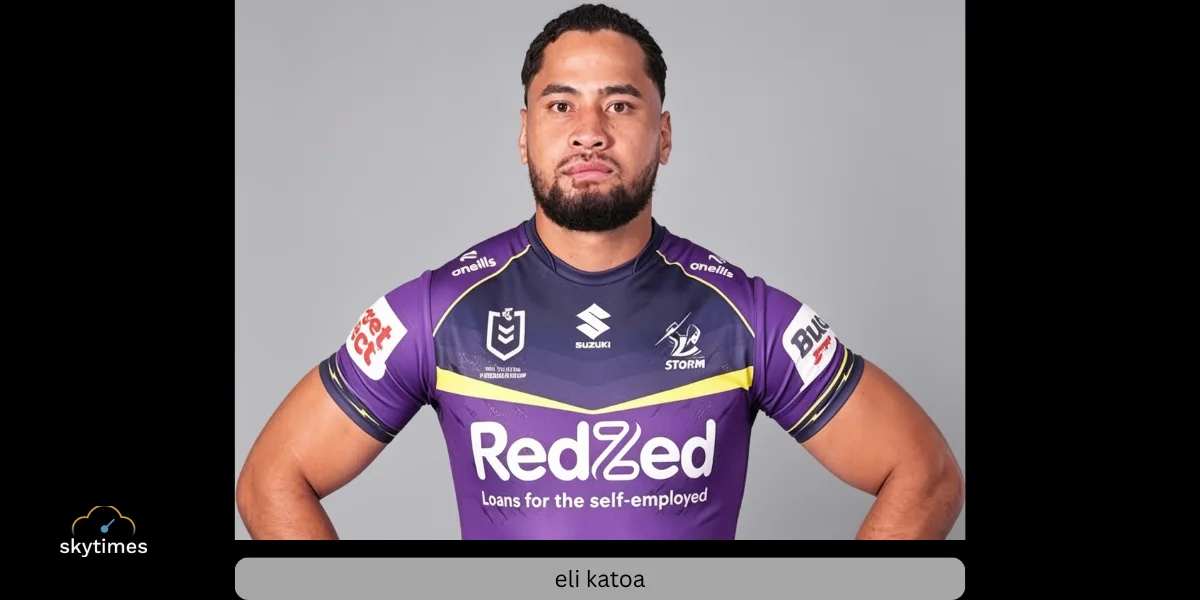
In every era of rugby league, a few forwards stand out not just for their size or strength, but for the way they change the energy of a game. Eliesa “Eli” Katoa is one of those players. From his early days in Tonga to becoming a key second-rower for the Melbourne Storm, Katoa has built a reputation as a powerful, hard-running edge forward with a tireless work ethic.
Today, his story is about more than line breaks and tackle counts. After a life-threatening head injury in late 2025, Katoa’s career sits at a crossroads — and his journey has become a stark case study in player welfare, concussion management, and resilience.
Early Life and Path to the NRL
Born on January 3, 2000, in Hihifo, Tonga, Eli Katoa’s rise is rooted in the familiar Pacific Islands narrative: raw talent, strong family foundations, and a deep love of rugby league.
Growing up in Tonga meant:
- Regular exposure to physical, community-based rugby from a young age.
- A strong emphasis on discipline, faith, and family values.
- Limited resources, but no shortage of ambition or work ethic.
Like many Tongan prospects, Katoa’s pathway relied on seizing opportunities abroad. By his late teen,s he had attracted the attention of NRL scouts, and his move into the New Zealand Warriors system set the stage for a rapid ascent.
Breakthrough with the New Zealand Warriors (2020–2022)
Katoa’s NRL debut came in Round 1 of the 2020 season for the Warriors against the Newcastle Knights. Debuting in such a physically demanding position as a second-row forward at top level is no small feat; doing it in the opening round signaled how highly the club rated him.
Across his time with the Warriors (2020–2022), several traits became clear:
- Explosive ball-carrying: He regularly bent the defensive line and won the ruck.
- Strong edge running lines: Katoa developed a knack for hitting gaps off his halfback.
- High work rate in defense: Willing to make repeated tackles over long minutes.
For a young forward, consistency can take time. The Warriors years were as much about learning the demands of the NRL — week in, week out collisions, travel, scrutiny — as about headline performances. They prepared him for the next, more refined phase of his career.
Evolution at the Melbourne Storm (From 2023)
The move to the Melbourne Storm in 2023 was a turning point. The Storm are renowned for turning promising athletes into polished professionals, particularly in the forward pack.
At Melbourne, Katoa:
- Quickly established himself as a starting second-rower.
- Benefited from the Storm’s highly structured systems and elite coaching standards.
- Developed greater defensive discipline and tactical awareness on the edge.
Career Highlights at the Storm
By 2024 and 2025, Katoa was no longer just a prospect — he was a proven NRL weapon.
Key milestones include:
- 2024 Season
- Played 25 matches.
- Helped Melbourne Storm reach the NRL Grand Final.
- Emerged as one of the competition’s most dangerous edge runners.
- 2025 Season
- 26 appearances.
- Integral player for the minor premiers, underlining his durability and value.
His performances were reflected in individual recognition: Katoa became a two-time Dally M Second Rower of the Year nominee, placing him among the elite in his position.
For coaches and analysts, Katoa’s game offers a template for the modern second-rower:
- Big body, but mobile.
- Capable of playing long minutes.
- Offers genuine attacking strike rather than just yardage carries.
International Stage: Representing Tonga
Katoa’s rise at club level naturally translated into international honors. Representing Tonga in the Pacific Championships, he embodied the powerful, passionate style that has made the Tongan national side such a force.
Internationally, his role has typically involved:
- Running hard edges against elite Test defenses.
- Providing leadership through effort and physicality.
- Bringing NRL professionalism back to the national setup.
For many Pacific Island players, international rugby is deeply personal — about family, heritage, and pride as much as trophies. Katoa fits that mould perfectly.
The 2025 Head Injury: A Turning Point
On November 2, 2025, during a Pacific Championships clash between Tonga and New Zealand, Katoa’s career took a dramatic and frightening turn.
What Happened
In that match, Katoa:
- Sustained three separate head knocks:
- One during warm-up.
- Two during the match itself.
- Subsequently developed a brain bleed.
- Suffered seizures, requiring emergency surgery.
This sequence transformed a routine international fixture into a critical medical emergency and a flashpoint in the ongoing debate around concussion management in rugby league.
Concussion Protocol Failures and Sanctions
Following the incident, an investigation concluded that concussion protocols had not been properly followed. The response was significant:
- Four Tongan officials were given two-year bans by the NRL.
- The ruling underscored how seriously the game’s administrators now treat head injuries.
From an expert perspective, this case encapsulates the non‑negotiable importance of strict, conservative concussion protocols:
- A player with a suspected head knock should be removed and fully assessed, no matter the match situation.
- Returning to the field after multiple incidents is an unacceptable risk in the modern game.
- Medical staff require both authority and backing to make player‑first decisions.
Katoa’s ordeal will remain a reference point in educational sessions around player welfare.
The Aftermath: Ruled Out for 2026
As a result of the brain bleed and subsequent surgery, Katoa was ruled out for the entire 2026 NRL season. For a 26‑year‑old reaching his prime, that is a significant blow.
The immediate implications:
- No club football in 2026 for the Melbourne Storm.
- A long and carefully managed rehabilitation process.
- Ongoing uncertainty around his long-term return to elite rugby league.
Yet there is also a positive thread: reports indicate that Katoa is undergoing rehabilitation and remains hopeful of returning to the sport he loves.
Expert View: What Makes Eli Katoa Special as a Second-Rower
Even with his future on hold, it’s important to recognise why Katoa was so highly regarded before the injury — and why clubs will be eager to support his recovery.
Key Strengths
- Powerful Running: Katoa consistently wins contact and generates post‑contact metres.
- Line-Running Intelligence: He times his runs to hit gaps, not just collide with defenders.
- Work Ethic: Willing to keep taking tough carries and work hard off the ball.
- Competitive Edge: Brings energy and intensity that lifts teammates.
Common Development Mistakes for Players in His Role
Younger second-rowers looking up to players like Katoa often fall into avoidable traps:
- Focusing only on size
- Mistake: Chasing bulk at the expense of mobility.
- Lesson: The modern game rewards power plus agility, not mass alone.
- Neglecting defensive detail
- Mistake: Relying on big hits instead of good technique and positioning.
- Lesson: Edge forwards must read shapes, make smart decisions, and close space.
- Overlooking recovery and welfare
- Mistake: Treating knocks and fatigue as just part of the grind.
- Lesson: Katoa’s story underlines that head knocks and symptoms must be taken seriously.
- Under‑developed communication
- Mistake: Leaving all organisation to halves and hookers.
- Lesson: High‑level second‑rowers talk constantly in defence and attack.
Practical Takeaways for Players and Coaches
Katoa’s career to date offers several practical lessons.
For Players
- Prioritise honest reporting of symptoms: If you feel “off” after a head knock, say so — immediately.
- Invest in technique: Good body position in contact reduces risk and improves performance.
- Develop an all‑round game: Work on running lines, tackling, fitness, and ball skills.
- Think long‑term: A week off now is better than a career cut short.
For Coaches and Support Staff
- Empower medical staff: They must have the final say on head injury decisions.
- Normalise coming off after head knocks: Remove any stigma around players leaving the field.
- Educate regularly: Use real cases, like Katoa’s, to reinforce the gravity of concussion.
- Monitor cumulative load: Consider training contact, match minutes, and recovery holistically.
Future Outlook: Can Eli Katoa Return?
At 26, time is still on Eli Katoa’s side — but caution will define his path back.
Key factors that will shape his future:
- Medical clearance: Independent specialists will determine if a safe return is possible.
- Neurological outcomes: Long-term brain health must come before any performance goals.
- Gradual reconditioning: Even if cleared, he’ll need staged contact loading and conditioning.
- Support systems: Club, family, and cultural support will be crucial.
If Katoa does return, he will bring back not only his physical presence but also a perspective shaped by a profound brush with the limits of the sport. If, in time, doctors recommend retirement, his experience could still play a vital role in mentoring younger forwards and advocating for player welfare.
Conclusion: A Career That Speaks to Both Brilliance and Vulnerability
Eliesa “Eli” Katoa’s story is, at once, the tale of a gifted second-row forward and a sobering reminder of rugby league’s risks. From Hihifo in Tonga to starring for the Melbourne Storm and representing his nation, he has already achieved more than most players ever will.
Yet his greatest test may be the one he faces off the field: recovering from a serious brain injury, navigating uncertainty, and deciding — with medical guidance — what comes next.
For players, coaches, and fans, Katoa’s journey underscores two truths:
- The modern edge forward must combine power, intelligence, and relentless work.
- Player safety, especially around head injuries, is not a negotiable extra — it is central to the game’s future.
Whatever the outcome of his rehabilitation, Eli Katoa has already made a lasting impact. His next chapter, whether in a jumper or in another capacity, will be watched with respect, concern, and admiration across the rugby league world.