
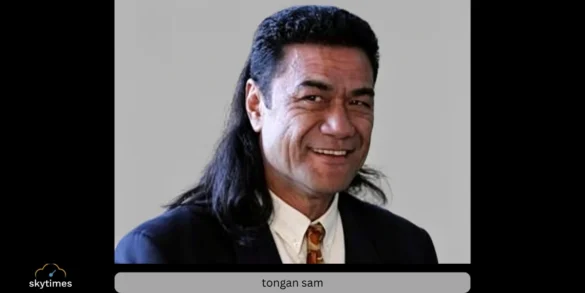
In the complex, neon-lit tapestry of Sydney’s modern history, few figures occupy as distinct, shadowy, and enduring a niche as Semi Ngata—universally known across the media, police taskforces, and the underground landscape as “Tongan Sam”. For decades, his name has served as a fixture in reports concerning the city’s volatile nightlife, high-stakes security operations, and the tight-knit, fiercely guarded inner circles of its most prominent families.
While largely removed from the public eye today, Ngata’s life story provides a fascinating window into an era of Sydney’s underworld defined by strict street codes, fierce personal loyalties, and the constant, underlying hum of violence.
Tongan Sam: Background and Cultural Heritage: The Crucible of Kings Cross
Semi Ngata’s journey into the public consciousness is inextricably linked to the golden era of Kings Cross. During the late 20th century, the “Cross” operated as the beating heart of Sydney’s entertainment, nightlife, and vice district—a high-energy environment where doors were guarded fiercely, and power dynamics shifted on a nightly basis.
Of Tongan descent, Ngata possessed an imposing physical stature coupled with a calm, resolute demeanor that quickly separated him from the volatile elements of the street. In an industry where reliability was currency, Ngata forged a reputation as an “old-school” operator. Unlike temporary security guards or flashy associates who drifted in and out of the scene, Ngata established himself as a permanent, immovable pillar. His nickname, “Tongan Sam,” became synonymous with absolute physical presence and an unyielding commitment to those he protected.
Tongan Sam: The Inner Circle: Alliance with John Ibrahim
The defining characteristic of Ngata’s public profile was his decades-long association with high-profile Sydney identity John Ibrahim. As Ibrahim rose to prominence as a dominant force in Kings Cross nightlife, managing venues and navigating intense police and media scrutiny, Ngata stood quietly and powerfully by his side as his trusted bodyguard and confidant.
The depth of their bond transcended standard employer-employee dynamics. In his biographical and autobiographical accounts, John Ibrahim immortalized Ngata’s status within his inner circle, describing him memorably as “the last of his kind: the old-school real tough men,” and noting with stark sincerity, “Even blood couldn’t make us closer.”
Operating in such close proximity to the apex of Sydney’s social and nightlife power structures meant that Ngata was frequently brushed by the turbulent winds swirling around the Ibrahim family. As taskforces scrutinized the commercial and security arrangements governing the Cross, figures within Ibrahim’s orbit routinely drew the attention of law enforcement agencies, placing Ngata under regular observation by intelligence analysts and specialized police units.
Tongan Sam: Encounters with Law Enforcement
Because of his central position within a high-scrutiny environment, Ngata’s name occasionally bled out of the shadows of private security and into public court listings and police briefs.
- The 2009 Taskforce Raids: As state and federal agencies intensified their focus on organized crime syndicates operating across Sydney, specialized gang-violence and drug-enforcement taskforces executed coordinated sweeps. In July 2009, Ngata’s residential property became the target of a high-profile raid conducted by a specialized gang taskforce, an operation that resulted in police locating bulk quantities of a methamphetamine precursor material. The event underscored the volatile realities of the circles intersecting with the nightlife industry, where personal associations frequently attracted systemic legal pressures.
- Family Legal Entanglements: The wider network surrounding Ngata also saw legal turbulence over the years. Incidents involving family members—such as investigations touching upon his son, Nimilote Ngata, amidst broader inquiries during the late 2000s—further tied the family name to the complex web of true-crime journalism chronicling Sydney’s criminal ecosystem.
Tongan Sam: The 2017 Merrylands Shooting: A Brazen Attack
The most dramatic and widely reported chapter of Ngata’s public life unfolded on a warm November evening in 2017. At the time, preparations were underway at a residential property in Merrylands, Western Sydney, for a high-profile family wedding uniting members of the Ibrahim circle with relatives of controversial former Auburn deputy mayor Salim Mehajer.
As workers and associates busied themselves setting up the backyard with flowers, chairs, and celebratory decor—with the pavement outside famously scrawled with the chalked words “Sam + Aisha 18.11.17”—tragedy struck. An intruder, believed by detectives to have slipped discreetly through a side fence under the cover of dusk, fired a shot directly into the backyard.
Semi Ngata, then 59 years old, was struck in the back by the gunfire. The brazen nature of the attack sent immediate shockwaves through Sydney’s law enforcement agencies and underworld networks alike, signaling that even private family sanctuaries were not immune to violent turf-style messaging.
Rushed to Westmead Hospital in a serious condition, Ngata underwent emergency surgery. By the following afternoon, medical staff listed him as stable. The hospital doors instantly became a media focal point; among the steady stream of concerned visitors was John Ibrahim himself. An image of Ibrahim arriving to check on his long-time confidant subsequently circulated widely across Australian news outlets, symbolizing the intense personal loyalty binding the men together through crisis. While police later investigated a burnt-out vehicle discovered nearby in Mays Hill, direct links to the shooting remained a subject of ongoing investigative speculation as detectives canvassed the neighborhood.
Tongan Sam: Public Perception and True-Crime Legacy
The public perception of Semi “Tongan Sam” Ngata has always remained bifurcated, heavily dependent on the lens through which observers view Sydney’s modern history.
To romanticists, nostalgia-driven commentators, and those who navigated the era, Ngata represented a bygone archetype: a stoic, fiercely loyal enforcer who adhered to a strict, traditional code of conduct. In an environment often characterized by backstabbing and shifting alliances, his unwavering dedication stood out as an anomaly of old-school honor.
Conversely, to law enforcement agencies, investigative journalists, and critics of Sydney’s nightlife economy, Ngata was emblematic of the darker, shadow-drenched infrastructure that enabled organized crime to flourish beneath the neon lights. His permanent fixture beside major underworld figures cast him as an instrumental component of a protective barrier insulating high-profile power players from accountability.
Current Status and Conclusion
As the years have passed, the landscape of Sydney has transformed dramatically. The golden, lawless era of Kings Cross has largely dissolved under heavy gentrification, strict licensing laws, and sweeping legislative reforms.
In this modern climate, Semi Ngata has transitioned gracefully out of the public eye. Leading a quiet life far removed from the media spotlights, flashing cameras, and hospital-door stakeouts that punctuated his earlier decades, he remains a living archive of a tumultuous era.
Ultimately, the story of “Tongan Sam” is a study in loyalty, physical endurance, and the heavy price of proximity to power. Whether viewed through the lens of a loyal guardian or a symbol of a rougher chapter in Sydney’s past, Ngata’s legacy is firmly etched into the true-crime history of Australia—the story of a silent giant who stood watch over a city at the height of its wild, unbridled days.
Ibrahim family involved in Sydney shooting
This archived news broadcast details the aftermath of the 2017 Merrylands shooting, highlighting the police response and the security climate surrounding associates of the Ibrahim family.